
How Many Rolls of Wallpaper Do I Need?
When planning a room transformation, the most pressing question is always: how many rolls of wallpaper do I need? Our Toronto wallpaper installation team calculates this by taking your total wall square footage, adding 10 to 30 percent for pattern repeat waste, and then ordering one extra roll for safety.
Finding yourself short on material mid-project is incredibly frustrating and costly. Our team sees this exact mistake happen on high-end sites across the Greater Toronto Area constantly.
Reordering takes weeks of waiting for shipping. The replacement paper frequently comes from a different dye lot, meaning the new panels will show a visible colour shift right on your wall.
We want to help you avoid a $200 mistake and frustrating project delays. Measuring correctly right from the start protects your investment.
Here is the exact mathematical approach used to finalize material counts before placing an order.
Step 1: Calculate Wall Area
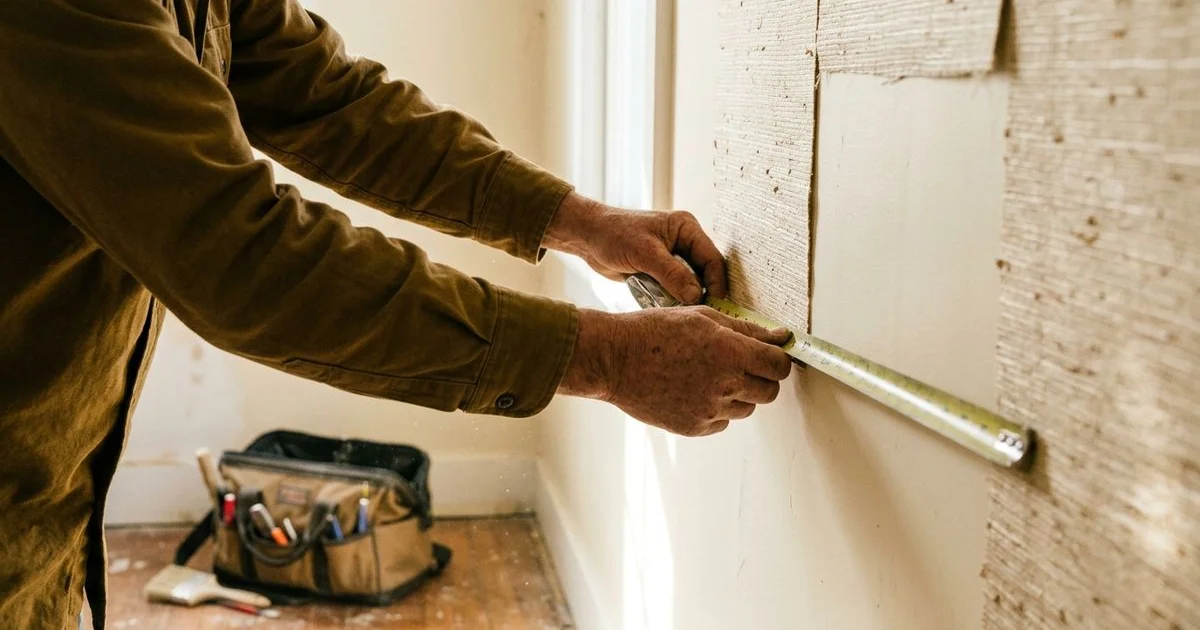
To find your base square footage, multiply the width by the height for every wall in the room, then add those totals together.
Our preferred method requires measuring the entire surface area without subtracting small architectural features. An average Ontario powder room is about 18 to 20 square feet in floor space, but the wall area quickly surpasses 100 square feet once you factor in nine-foot ceilings.
Follow these specific measuring rules to ensure accuracy:
- Measure ceiling height in multiple spots: Floors settle, so take the highest measurement to avoid gaps.
- Ignore small trim: Do not deduct space for baseboards or window casings.
- Subtract major openings: Only deduct full doors and large, floor-to-ceiling windows.
Step 2: Apply the Pattern Repeat Waste Factor
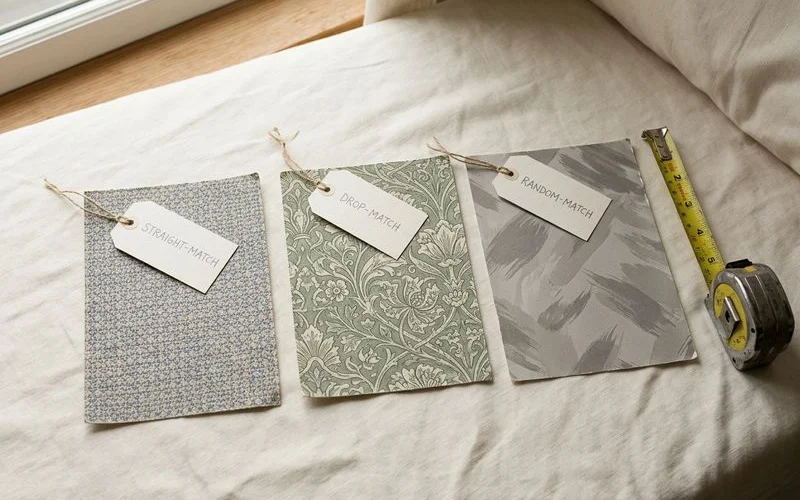
Multiply your base wall area by the waste percentage associated with your specific pattern match type. The pattern repeat dictates how much paper gets cut off and thrown away to make the design line up perfectly at the seams.
Our installers see clients undercount this metric constantly, leading to major shortages. Large, complex designs like the South Asian and Arabesque florals currently popular in high-end Toronto condos often require an extra 20 to 30 percent in material. The installer must trim significant lengths off each new strip just to find the next matching element.
This chart shows typical waste estimates based on match types:
| Match Type | Repeat Distance | Waste Factor |
|---|---|---|
| Random match | None, paper aligns anywhere | 0% (none) |
| Straight match (small repeat) | Under 6 inches | ~10% |
| Drop match (medium) | 6 to 18 inches | ~20% |
| Drop match (large) | Over 18 inches | ~30% |
We calculate the final effective area by multiplying the base square footage by this waste factor. For a 117-square-foot room featuring a large 12-inch drop match, you multiply 117 by 1.20 to get 140.4 square feet of required coverage.
Step 3: Calculate Roll Count
Divide your total effective area by the specific wallpaper coverage per roll provided by your selected brand. This calculation tells you exactly how many wallpaper rolls per room you need to purchase.
Our industry uses two distinct sizing standards that heavily impact this math. Standard North American single rolls generally cover 28 to 30 square feet of wall space. European manufacturers, such as Farrow & Ball or York Wallcoverings, typically sell double rolls that provide about 56 to 57 square feet of coverage.
Review this example using a standard single roll:
- Effective area: 140.4 sq ft
- Per-roll coverage: 28 sq ft (single roll)
- Rolls needed: 140.4 ÷ 28 = 5.01
- Rounding rule: Always round up to the next whole number, resulting in 6 rolls.
We always check the manufacturer’s label directly, as physical roll widths vary widely from 20.5 inches to 36 inches. A double roll of York Wallcoverings Lotus Silk, for instance, covers 57.37 square feet, which completely changes the final divisor in your math.
Step 4: Always Order One Extra
You must purchase one additional roll above your calculated mathematical requirement. This strict buffer protects your project from unexpected installation errors and guarantees you have matching material for future touch-ups.
Our standard policy makes this extra roll non-negotiable for every local project. Luxury brands print paper in specific batches called dye lots. Ordering a replacement roll of Farrow & Ball Tented Stripe three weeks later often results in a subtle colour shift that ruins the flawless look of a $10-per-square-foot installation.
Here is why a spare roll is critical:
- Installation damage: Tools occasionally slip, or a panel tears during tricky corner wrapping.
- Future repairs: Water leaks or accidental dents five years down the line require matching paper from the exact same print run.
- Batch consistency: Reordering after the initial run guarantees colour variations across the wall.
We finalize the example project by taking the calculated 6 rolls and adding the safety buffer. The true final order becomes 7 single rolls, or 4 double rolls, ensuring absolute peace of mind.
A Note on Luxury and Hand-Printed Paper
Luxury installations require custom mathematical models because manufacturers sequence these panels specifically for your exact wall dimensions. Hand-painted products do not follow standard roll sizes or drop match formulas.
Our specialised Toronto crews calculate these high-end orders physically on-site after taking precise structural measurements. Colour batching, panel sequencing, and per-panel ordering completely change how the installation flows.
Products like grasscloth, silk, hand-printed, and de Gournay panels demand perfect precision.
Precision is paramount with luxury materials. An incorrect measurement on a premium silk panel ruins the entire sequence and causes massive financial loss.
We always consult directly with the client’s designer before finalizing counts on these delicate materials.
Try the Free Calculator
Our online tool instantly processes your room dimensions to generate a highly accurate material estimate. This digital wallpaper rolls calculator manages the complex math automatically.
Entering your wall width, height, and pattern repeat data takes only a few seconds. We programmed the system to factor in varying roll sizes and the mandatory safety buffer.
Running your numbers here acts as a crucial sanity check against supplier quotes before you finalize the purchase. Once you know your roll count, pair it with our breakdown of wallpaper installation cost in Ontario to project a realistic total project budget.
Stop wondering exactly how many rolls of wallpaper do I need for a flawless finish.
We invite you to try the free Wallpaper Roll Calculator right now to plan your premium installation with total confidence.